Enterprise Java Expertise: JEE/Java Solutions Across Industries
The Foundation: Java/JEE as Enterprise Backbone
For nearly two decades, Java has been the backbone of enterprise software development—and for good reason:
- Platform independence: “Write once, run anywhere” (JVM on Windows, Linux, cloud)
- Mature ecosystem: Frameworks, libraries, tools refined over 25+ years
- Scalability: From small departmental apps to global e-commerce platforms
- Security: Robust security frameworks, compliance certifications (FIPS, HIPAA, etc.)
- Talent pool: Large community of experienced Java developers worldwide
Since 2006, we’ve architected and built custom web applications—both cloud and on-premise—leveraging Java/JEE’s strengths across diverse industries: healthcare, pharmaceuticals, automotive, publishing, finance, and more.
This post explores our Java platform expertise through the lens of two representative domains: healthcare (talent acquisition, pharmaceutical supply chains) and core platform technologies (application servers, frameworks, architectures).
Part 1: Healthcare Solutions with Java
Healthcare Talent Acquisition Platform (2012-2015)
The Challenge
Healthcare organizations face unique recruiting challenges:
- Specialized roles: Nurses, physicians, therapists, lab technicians—each with certifications, licenses, specializations
- Regulatory compliance: Background checks, license verification, credentialing (JCAHO, state medical boards)
- High volume: Large hospital systems hiring hundreds of clinical staff annually
- Retention tracking: Managing temp staff, contract renewals, permanent conversions
- Integration needs: HRIS systems (Workday, SAP SuccessFactors), ATS (Applicant Tracking Systems), credentialing databases
The Solution: Custom Talent Acquisition Platform
Technology Stack:
- Application Server: Glassfish 4 (Java EE 7)
- Framework: Java EE (EJB 3.2, JPA 2.1, JAX-RS)
- Frontend: PrimeFaces (JSF-based UI framework)
- Database: Oracle 12c (high-volume transactional data)
- Integration: SOAP/REST web services for HRIS, background check providers
- Reporting: Jasper Reports for compliance reports
Core Features:
1. Candidate Management:
- Profile tracking: Certifications, licenses (with expiration alerts), specializations, work history
- Document management: Resumes, transcripts, license scans, reference letters
- Skills matching: Automated matching of candidate profiles to open positions based on required certifications/experience
2. Credentialing Workflow (Camunda BPM):
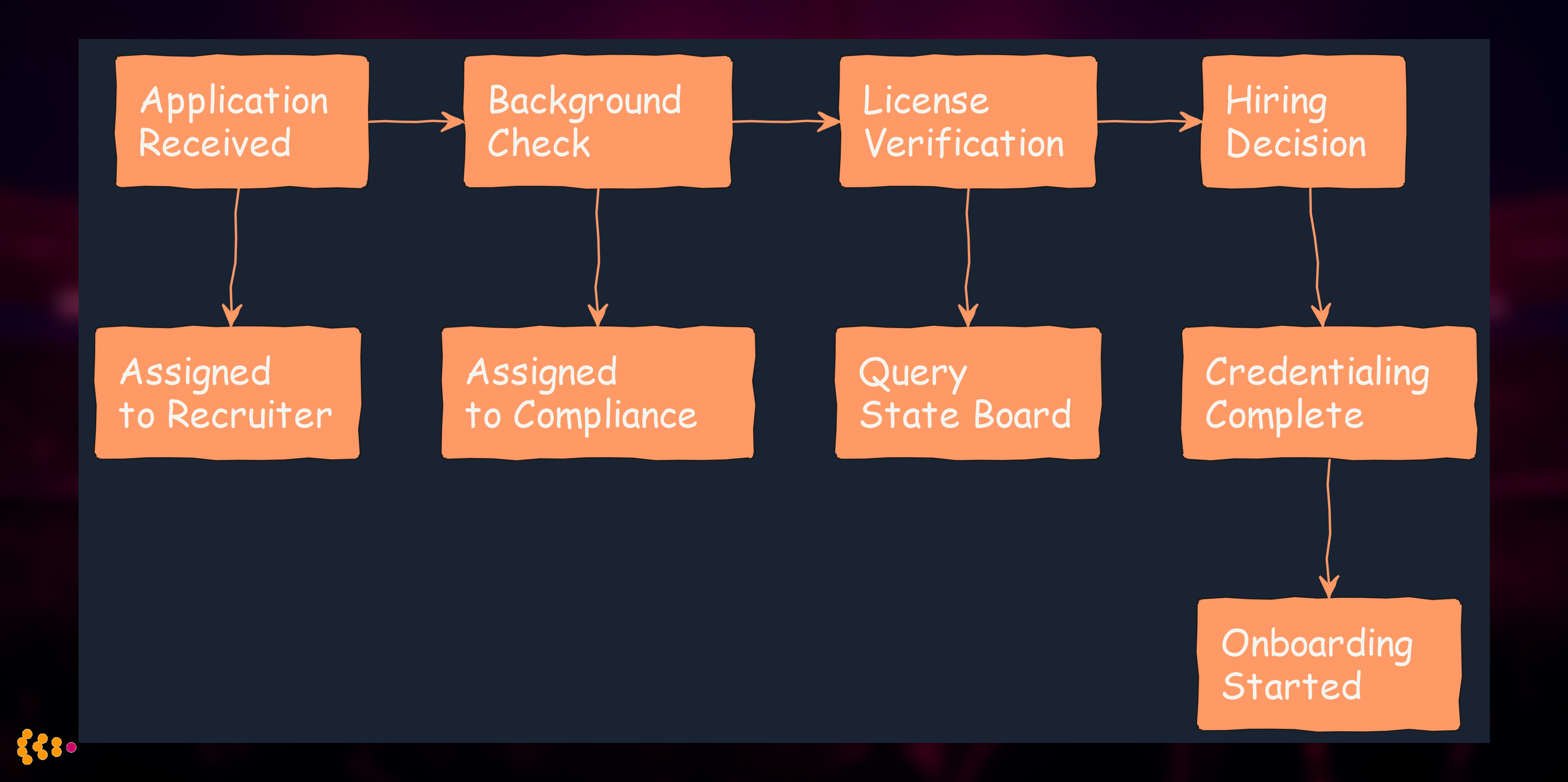
- Multi-step process: Application → Background check → License verification → Reference checks → Final approval
- Task assignment: Automated routing to credentialing specialists based on role type
- Compliance tracking: Audit trail for regulatory inspections
Camunda BPMN workflow:
3. Integration with External Systems:
- HRIS sync: Candidates → Workday employees automatically
- Background checks: Sterling, Checkr API integration
- License verification: Automated state board queries
License Verification API (simplified):
@Path("/api/license-verification")
public class LicenseVerificationResource {
    @POST
    public Response initiateLicenseVerification(LicenseVerificationRequest request) {
        LicenseStatus status = licenseService.verifyLicense(
            request.getLicenseNumber(), request.getState(), request.getProfession());
        // Store result and trigger Camunda workflow
        licenseService.saveVerificationResult(result);
        camundaRuntimeService.signal(request.getProcessInstanceId());
        return Response.ok(result).build();
    }
}
4. Compliance Reporting:
- Regulatory reports: JCAHO-compliant reports showing credentialing completion rates, pending verifications
- Audit trails: Every action logged (who accessed what data, when)
- Scheduled reports: Weekly hiring pipeline reports emailed to hiring managers
Results
- Time reduction: Credentialing process reduced from 45 days to 18 days (automated verification)
- Compliance: 100% audit pass rate for JCAHO inspections (complete audit trails)
- Volume handling: System processed 2,000+ candidates annually across 3 hospital systems
- User adoption: 95% of recruiters and hiring managers actively using platform within 3 months
Pharmaceutical Supply Chain Tracing (2018-2020)
We’ve covered this project in detail in our Pharmaceutical Blockchain case study, but here we’ll highlight the JEE/Java platform aspects.
Technology Stack
Blockchain Layer:
- Hyperledger Fabric 1.4+: Permissioned blockchain for immutable ledger
- Chaincode (Smart Contracts): Written in Go (Hyperledger standard)
Application Layer (Java/JEE):
- Spring Boot 2.x: Microservices architecture
- Spring Cloud: Service discovery (Eureka), API gateway (Zuul), config management
- Fabric SDK Java: Java client for interacting with Hyperledger Fabric network
- PostgreSQL: Off-chain data storage for performance (on-chain for immutability)
- Kafka: Event streaming for real-time supply chain updates
Integration Layer:
- REST APIs: Exposing blockchain queries to ERP, warehouse management systems
- SOAP web services: Legacy ERP integration (SAP, Oracle E-Business Suite)
- Batch processing: Spring Batch for bulk data synchronization
Architectural Highlights
Microservices Design:
┌─────────────────────────────────────────────────────────────────┐
│                    API Gateway (Zuul)                           │
│                  (Authentication, Rate Limiting)                │
└─────────────────────────────────────────────────────────────────┘
         ↓                ↓                  ↓
┌──────────────┐  ┌──────────────┐  ┌──────────────────┐
│ Product Svc  │  │ Shipment Svc │  │ Verification Svc │
│ (Spring Boot)│  │ (Spring Boot)│  │  (Spring Boot)   │
└──────────────┘  └──────────────┘  └──────────────────┘
         ↓                ↓                  ↓
┌─────────────────────────────────────────────────────────┐
│         Hyperledger Fabric Network (Blockchain)         │
│  (Product Registry, Custody Chain, Event Audit Log)     │
└─────────────────────────────────────────────────────────┘
Product Service (example):
@RestController
@RequestMapping("/api/products")
public class ProductController {

    @Autowired
    private FabricGateway fabricGateway;

    @PostMapping("/register")
    public ResponseEntity<ProductRegistration> registerProduct(
            @RequestBody ProductDTO product) {

        // Validate product data (GS1 GTIN, NDC, etc.)
        validateProductIdentifiers(product);

        // Invoke Hyperledger Fabric chaincode
        Contract contract = fabricGateway.getNetwork("pharma-channel")
            .getContract("product-chaincode");

        byte[] result = contract.submitTransaction(
            "registerProduct",
            product.getGtin(),
            product.getNdc(),
            product.getManufacturer(),
            product.getBatchNumber(),
            product.getExpirationDate().toString()
        );

        // Parse blockchain response
        ProductRegistration registration =
            objectMapper.readValue(result, ProductRegistration.class);

        // Store metadata in PostgreSQL for fast queries
        productRepository.save(toEntity(registration));

        // Publish event to Kafka
        kafkaTemplate.send("product-registered", registration);

        return ResponseEntity.status(HttpStatus.CREATED).body(registration);
    }

    @GetMapping("/{gtin}/history")
    public ResponseEntity<List<CustodyEvent>> getProductHistory(
            @PathVariable String gtin) {

        // Query Hyperledger Fabric for immutable history
        Contract contract = fabricGateway.getNetwork("pharma-channel")
            .getContract("product-chaincode");

        byte[] result = contract.evaluateTransaction("getProductHistory", gtin);

        List<CustodyEvent> history =
            objectMapper.readValue(result, new TypeReference<List<CustodyEvent>>(){});

        return ResponseEntity.ok(history);
    }
}
Key Java/JEE Patterns:
1. Saga Pattern for Distributed Transactions:
- Product registration spans multiple services (Product Service, Blockchain, ERP)
- If any step fails, compensating transactions roll back changes
- Orchestration via Spring State Machine
2. CQRS (Command Query Responsibility Segregation):
- Write model: Submit transactions to blockchain (slow, immutable)
- Read model: Query PostgreSQL (fast, eventually consistent with blockchain)
- Event sourcing: Kafka events update read model when blockchain confirms
3. Resilience Patterns:
- Circuit breaker (Hystrix): If blockchain network is slow/unavailable, fail fast
- Retry with exponential backoff: Transient network failures retry automatically
- Bulkhead: Isolate blockchain calls to separate thread pool (doesn’t block REST API)
Results (Java Platform Perspective)
- Throughput: Handled 50,000+ supply chain events per day (Kafka + Spring Boot microservices)
- Latency: 95th percentile API response time <500ms (PostgreSQL read model)
- Availability: 99.9% uptime (Kubernetes orchestration, auto-scaling)
- Developer productivity: Spring Boot reduced boilerplate code, faster feature delivery
Part 2: JEE/Java Platform Technologies
Application Servers: From J2EE to Cloud-Native
Our experience spans the evolution of Java application servers:
Classic Java EE Servers (2006-2015)
Payara / Glassfish:
- Payara: Commercial fork of Glassfish with enhanced support, micro-profile compatibility
- Use cases: Full Java EE compliance needed (EJB, JMS, JPA, JSF all in one server)
- Strengths: Easy clustering, excellent JMX monitoring, web admin console
- Projects: Healthcare talent acquisition, government portals, financial reporting systems
BEA WebLogic (later Oracle WebLogic):
- Enterprise-grade: Used by Fortune 500 companies for mission-critical apps
- Use cases: Large-scale e-commerce, banking, insurance (our ticketing system ran on WebLogic)
- Strengths: Rock-solid clustering, transaction management, JMS performance
- Challenges: Licensing costs, complex configuration
IBM WebSphere:
- IBM ecosystem: Tight integration with DB2, MQ Series, CICS
- Use cases: Clients with existing IBM infrastructure
- Strengths: Mature tooling (RAD/RSA), excellent transaction management
- Challenges: Heavyweight, long startup times
Modern Lightweight Servers (2015-Present)
Spring Boot with Embedded Tomcat/Jetty:
- Philosophy: “Opinionated defaults” for rapid development
- Deployment: Fat JAR with embedded server (no separate app server install)
- Use cases: Microservices, cloud deployments, DevOps-friendly apps
- Strengths: Fast startup, minimal config, excellent Spring ecosystem integration
Quarkus / Micronaut (2019+):
- Next-gen: GraalVM native image compilation for sub-second startup, minimal memory
- Use cases: Serverless functions (AWS Lambda), Kubernetes-native microservices
- Strengths: Performance, small container images, cloud-native from day one
Frameworks and Libraries
Spring Ecosystem
Spring Framework (Dependency Injection, AOP):
@Service
public class OrderService {
    private final OrderRepository orderRepository;
    private final EmailService emailService;

    // Constructor injection (Spring 4.3+)
    public OrderService(OrderRepository orderRepository,
                        EmailService emailService) {
        this.orderRepository = orderRepository;
        this.emailService = emailService;
    }

    @Transactional
    public Order createOrder(OrderRequest request) {
        Order order = new Order();
        order.setCustomerId(request.getCustomerId());
        order.setItems(request.getItems());

        Order savedOrder = orderRepository.save(order);

        // Send confirmation email (transactional outbox pattern)
        emailService.sendOrderConfirmation(savedOrder);

        return savedOrder;
    }
}
Spring Boot:
- Auto-configuration: Automatically configures DataSource, JPA, Security based on classpath
- Actuator: Production-ready metrics, health checks (
/actuator/health,/actuator/metrics) - Example: Pharmaceutical blockchain project (microservices)
Spring Cloud:
- Distributed systems: Service discovery, config servers, circuit breakers
- Netflix OSS: Eureka (discovery), Zuul (API gateway), Hystrix (circuit breaker), Ribbon (load balancing)
- Example: Pharmaceutical blockchain (microservices orchestration)
Grails (Groovy on Rails)
Groovy-based: Rapid web development with convention-over-configuration
- Use cases: Admin panels, internal tools where development speed matters
- Strengths: Scaffolding generates CRUD operations automatically, GORM (ORM) is powerful
- Projects: Publishing industry CMS prototypes, data management tools
Camunda BPM
Workflow orchestration: BPMN 2.0 for complex business processes
@Autowired
private RuntimeService runtimeService;

// Start a process instance
ProcessInstance processInstance = runtimeService.startProcessInstanceByKey(
    "credentialing-process",
    Map.of(
        "candidateId", candidateId,
        "positionType", "RN", // Registered Nurse
        "urgency", "high"
    )
);

// Query active tasks
List<Task> tasks = taskService.createTaskQuery()
    .processInstanceId(processInstance.getId())
    .taskAssignee("compliance-team")
    .list();
Use cases:
- Healthcare credentialing workflows
- Insurance claims processing
- Order fulfillment pipelines
Apache Kafka
Event streaming: Real-time data pipelines, event sourcing
@Service
public class SupplyChainEventProducer {

    @Autowired
    private KafkaTemplate<String, SupplyChainEvent> kafkaTemplate;

    public void publishShipmentEvent(Shipment shipment) {
        SupplyChainEvent event = new SupplyChainEvent();
        event.setEventType("SHIPMENT_DEPARTED");
        event.setShipmentId(shipment.getId());
        event.setTimestamp(Instant.now());
        event.setLocation(shipment.getCurrentLocation());

        kafkaTemplate.send("supply-chain-events", shipment.getId(), event);
    }
}
Use cases:
- Pharmaceutical supply chain (event sourcing)
- Automotive data hub (system synchronization)
- IoT telemetry ingestion (connected vehicle data)
Frontend Frameworks (Java-Integrated)
Angular (TypeScript)
Modern SPA: Component-based architecture, REST API integration
@Component({
  selector: 'app-product-search',
  templateUrl: './product-search.component.html'
})
export class ProductSearchComponent {
  products: Product[] = [];

  constructor(private productService: ProductService) {}

  search(query: string): void {
    this.productService.searchProducts(query)
      .subscribe(products => this.products = products);
  }
}

// Service calling Spring Boot REST API
@Injectable()
export class ProductService {
  constructor(private http: HttpClient) {}

  searchProducts(query: string): Observable<Product[]> {
    return this.http.get<Product[]>(`/api/products?q=${query}`);
  }
}
Projects: Pharmaceutical blockchain portal, publishing CMS, automotive engineering portal
Vaadin (Java-based UI)
Pure Java: Build web UIs entirely in Java (no JavaScript)
@Route("products")
public class ProductView extends VerticalLayout {

    private Grid<Product> grid = new Grid<>(Product.class);
    private TextField searchField = new TextField("Search");

    @Autowired
    private ProductService productService;

    public ProductView() {
        searchField.addValueChangeListener(e -> updateList());
        grid.setColumns("gtin", "name", "manufacturer", "expirationDate");

        add(searchField, grid);
        updateList();
    }

    private void updateList() {
        grid.setItems(productService.search(searchField.getValue()));
    }
}
Use cases: Internal admin panels, data entry applications (rapid development)
Struts / JSF / PrimeFaces (Legacy)
Classic Java web frameworks: Still maintained in legacy systems
- Struts 2: MVC framework (pre-Spring MVC dominance)
- JSF: Component-based (PrimeFaces, RichFaces for rich UI widgets)
- Use cases: Maintaining legacy applications, gradual migration to modern frameworks
ExtJS (JavaScript)
Rich desktop-like UIs: Grid components, drag-and-drop, complex layouts
- Backend: Spring Boot REST APIs
- Use cases: Data-heavy applications (analytics dashboards, ERP modules)
JHipster: Full-Stack Generator
Rapid application scaffolding: Generates Spring Boot + Angular/React/Vue app with best practices
jhipster
# Interactive prompts:
# - Application type: Monolith / Microservices / Gateway
# - Database: PostgreSQL / MySQL / MongoDB
# - Frontend: Angular / React / Vue
# - Security: JWT / OAuth 2.0
# - CI/CD: Jenkins / GitLab CI / GitHub Actions

# Result: Complete application with:
# - User management (registration, login, password reset)
# - Entity CRUD generation (JPA entities + REST APIs + Frontend forms)
# - Security configured
# - Docker Compose files for local development
# - CI/CD pipeline ready
Use cases:
- MVP development (get to production fast)
- Internal tools (user management, CRUD operations out of the box)
- Prototyping (validate ideas before custom development)
Architectural Patterns
1. Monolith vs. Microservices
Monolith (Single deployable unit):
- Pros: Simpler deployment, easier development for small teams, single database transaction
- Cons: Scalability limits (scale entire app, not individual services), technology lock-in
- Use cases: Early-stage startups, internal tools, applications with well-defined boundaries
Microservices (Distributed services):
- Pros: Scale services independently, technology diversity (Java for some, Node.js for others), team autonomy
- Cons: Distributed transactions (complexity), network latency, operational overhead (more containers to manage)
- Use cases: Large organizations, high-scale systems (pharmaceutical blockchain, automotive data hub)
Our approach: Start monolith, extract microservices as scale demands. “Monolith-first” avoids premature complexity.
2. Layered Architecture
Classic enterprise pattern:
┌─────────────────────────────────────┐
│      Presentation Layer             │  (REST Controllers, JSF Views)
├─────────────────────────────────────┤
│      Service/Business Logic Layer   │  (Services, Business Rules)
├─────────────────────────────────────┤
│      Data Access Layer              │  (JPA Repositories, DAOs)
├─────────────────────────────────────┤
│      Database                       │  (PostgreSQL, Oracle, etc.)
└─────────────────────────────────────┘
Benefits: Clear separation of concerns, testable layers, swappable persistence
3. Hexagonal Architecture (Ports and Adapters)
Core domain isolated from external dependencies:
┌───────────────────────────────────────────┐
│          Core Domain Logic                │
│   (Business rules, entities, use cases)   │
└───────────────────────────────────────────┘
      ↑ Ports (interfaces)      ↓
┌─────────────┐          ┌─────────────┐
│  REST API   │          │ PostgreSQL  │
│  (Adapter)  │          │  (Adapter)  │
└─────────────┘          └─────────────┘
      ↑                         ↓
┌─────────────┐          ┌─────────────┐
│ CLI Command │          │ Kafka Event │
│  (Adapter)  │          │  (Adapter)  │
└─────────────┘          └─────────────┘
Benefits: Core logic unaware of REST, databases, messaging. Easy to swap adapters (e.g., PostgreSQL → MongoDB).
Use cases: Pharmaceutical blockchain (core ledger logic independent of REST API, ERP integration)
DevOps and Deployment
Containerization (Docker)
Every Java app we build since 2017 is containerized:
Dockerfile (Spring Boot example):
FROM openjdk:17-jdk-slim AS builder
WORKDIR /app
COPY pom.xml .
COPY src ./src
RUN mvn clean package -DskipTests

FROM openjdk:17-jre-slim
WORKDIR /app
COPY --from=builder /app/target/*.jar app.jar
EXPOSE 8080
ENTRYPOINT ["java", "-jar", "app.jar"]
Benefits: Consistent environments (dev, test, prod), easy scaling (Kubernetes), faster deployments
Orchestration (Kubernetes)
Production deployments on Kubernetes:
apiVersion: apps/v1
kind: Deployment
metadata:
  name: product-service
spec:
  replicas: 3
  selector:
    matchLabels:
      app: product-service
  template:
    metadata:
      labels:
        app: product-service
    spec:
      containers:
      - name: product-service
        image: myregistry/product-service:1.2.3
        ports:
        - containerPort: 8080
        env:
        - name: SPRING_DATASOURCE_URL
          valueFrom:
            secretKeyRef:
              name: db-credentials
              key: jdbc-url
        resources:
          requests:
            memory: "512Mi"
            cpu: "500m"
          limits:
            memory: "1Gi"
            cpu: "1000m"
        livenessProbe:
          httpGet:
            path: /actuator/health
            port: 8080
          initialDelaySeconds: 60
          periodSeconds: 10
Features:
- Auto-scaling: Horizontal pod autoscaler (scale based on CPU/memory)
- Rolling updates: Zero-downtime deployments
- Self-healing: Restart failed pods automatically
CI/CD Pipelines
GitLab CI/CD (pharmaceutical blockchain project):
stages:
  - build
  - test
  - deploy

build:
  stage: build
  script:
    - mvn clean compile
  artifacts:
    paths:
      - target/

test:
  stage: test
  script:
    - mvn test
    - mvn jacoco:report
  coverage: '/Total.*?([0-9]{1,3})%/'

deploy-staging:
  stage: deploy
  script:
    - mvn package -DskipTests
    - docker build -t $CI_REGISTRY_IMAGE:$CI_COMMIT_SHA .
    - docker push $CI_REGISTRY_IMAGE:$CI_COMMIT_SHA
    - kubectl set image deployment/product-service product-service=$CI_REGISTRY_IMAGE:$CI_COMMIT_SHA
  environment:
    name: staging
  only:
    - develop

deploy-production:
  stage: deploy
  script:
    - mvn package -DskipTests
    - docker build -t $CI_REGISTRY_IMAGE:$CI_COMMIT_TAG .
    - docker push $CI_REGISTRY_IMAGE:$CI_COMMIT_TAG
    - kubectl set image deployment/product-service product-service=$CI_REGISTRY_IMAGE:$CI_COMMIT_TAG
  environment:
    name: production
  only:
    - tags
  when: manual
Lessons Learned: Java Since 2006
1. Frameworks Come and Go, Fundamentals Remain
Struts → Spring MVC → Spring Boot: Frameworks evolve, but HTTP, JDBC, transactions, security principles stay constant. Invest in understanding fundamentals.
2. Don’t Over-Engineer Early
Microservices, event sourcing, CQRS are powerful—but complex. Start simple (monolith, relational DB, straightforward layering). Refactor when complexity/scale demands it.
3. Observability from Day One
Logging, metrics, distributed tracing (Spring Boot Actuator, Prometheus, Zipkin) should be built in from the start. Debugging production issues without observability is painful.
4. Automated Testing is Non-Negotiable
Unit tests, integration tests, contract tests: Every project we build has >80% code coverage target. Saves countless hours debugging regressions.
5. Cloud-Native Thinking
12-Factor App principles (config in environment, stateless processes, log to stdout) apply even for on-premise deployments. Makes migration to cloud seamless.
Conclusion
Since 2006, we’ve built robust, scalable Java/JEE applications across industries—from healthcare talent acquisition and pharmaceutical supply chain tracing to automotive integration, publishing platforms, and beyond.
Our technology stack has evolved with the industry:
- Classic Java EE servers (Payara, WebLogic, WebSphere) for enterprise compliance
- Spring Boot microservices for cloud-native, DevOps-friendly architectures
- Camunda BPM for complex business workflows
- Kafka for event-driven architectures
- Frontend frameworks (Angular, Vaadin, React) for modern user experiences
But our core strength remains constant: delivering business value through well-architected, maintainable, scalable Java applications—whether on-premise, in the cloud, or hybrid.
Technologies Mentioned: Java, JEE, Payara, Glassfish, BEA WebLogic, IBM WebSphere, Spring Framework, Spring Boot, Spring Cloud, Grails, Camunda BPM, Apache Kafka, JHipster, Angular, Vaadin, Struts, JSF, PrimeFaces, ExtJS, Hyperledger Fabric, Docker, Kubernetes, GitLab CI/CD, PostgreSQL, Oracle, Maven
Industries Served: Healthcare, Pharmaceuticals, Automotive, Publishing, Finance, Government, Manufacturing
Contact: Building enterprise Java applications or modernizing legacy systems? Let’s discuss your needs.