Digital Publishing Excellence: CMS, Automation, and Global Reach Since 2011
The Modern Publishing Challenge
The publishing industry has undergone a digital transformation over the past decade and a half. Today’s publishers must:
- Manage multi-format content: Print books, e-books (EPUB, MOBI, PDF), audiobooks, video courses, online articles
- Reach global markets: Amazon KDP, IngramSpark, local distributors, direct-to-consumer websites
- Automate production: Audio narration, video editing, cover design, formatting—manual processes don’t scale
- Integrate systems: Author management, royalty tracking, marketing automation, distribution, analytics
- Respond to trends: Rapid adaptation to new formats (e.g., AI narration, interactive content)
Since 2011, we’ve been helping publishers across the EU and worldwide build the technical infrastructure to thrive in this complex landscape.
Content Management Systems: Beyond Off-the-Shelf Solutions
The Problem with Generic CMS Platforms
Publishers often start with generic CMS platforms like WordPress, Drupal, or commercial DAM (Digital Asset Management) systems. These work for blogs and basic websites, but fall short for publishing workflows:
Missing Capabilities:
- Version control for manuscripts: Track editorial changes, manage contributor revisions
- Metadata-rich management: ISBNs, copyright info, rights territories, contributor royalty splits
- Multi-format rendering: Single source content → EPUB, PDF (print), PDF (digital), web HTML
- Production workflow automation: Manuscript → editing → proofreading → formatting → publication
- Rights management: Track which territories/formats are licensed for each title
Custom CMS: Built for Publishers
We design and implement custom CMS platforms tailored to publishing workflows.
Architecture:
┌─────────────────────────────────────────────────────────────┐
│                    Publishing CMS Core                      │
├─────────────────────────────────────────────────────────────┤
│  Content Repository (Git-based version control)             │
│  Metadata Management (ISBN, rights, contributors, etc.)     │
│  Workflow Engine (Camunda BPMN for editorial processes)     │
│  Multi-format Renderer (Pandoc, LaTeX, custom converters)   │
│  Asset Management (covers, illustrations, media files)      │
└─────────────────────────────────────────────────────────────┘
         ↓                    ↓                    ↓
   Web Portal          Editor Interface      API Layer
  (Public-facing)    (Staff & Contributors)  (Integrations)
Technology Stack:
- Backend: Java/Spring Boot, PostgreSQL for metadata, Git for content versioning
- Workflow: Camunda BPMN (business process modeling for editorial workflows)
- Content Processing: Pandoc (Markdown → multiple formats), LaTeX (high-quality print PDFs)
- Frontend: Angular or React for editor/author interfaces
- API: RESTful APIs for integrations with Amazon KDP, print-on-demand services, analytics
Use Case: Multi-Language Educational Publisher
Client: European educational publisher with titles in 8 languages, distributed globally.
Challenges:
- Managing translations (same content, 8 language variants)
- Coordinating contributors (authors, translators, illustrators, editors)
- Publishing to multiple channels (print, e-book, teacher portals)
- Tracking rights (different licenses per territory and format)
Solution:
Content Structure:
Title: "Introduction to Climate Science"
├── Metadata: ISBN (per format/language), rights territories, contributors
├── Content Variants:
│   ├── English (original)
│   ├── German (translation)
│   ├── French (translation)
│   └── ... (6 more languages)
├── Assets:
│   ├── Cover designs (per language)
│   ├── Illustrations (shared across languages)
│   └── Diagrams (localized text overlays per language)
└── Output Formats:
    ├── Print PDF (per language)
    ├── EPUB (per language)
    ├── Web portal (HTML, per language)
    └── Teacher's guide PDF
Workflow:
- Author submits English manuscript (Markdown format for easy editing)
- Editor reviews, makes inline comments (version-controlled in Git)
- Approved manuscript triggers translation workflow (tasks assigned to translators via CMS)
- Translators work in CMS interface, see original text + translation side-by-side
- Automated build generates EPUB and PDF for each language on commit
- Quality check (automated: links, formatting; manual: content review)
- Publication to web portal, print-on-demand (via API), Amazon KDP (automated upload)
Results:
- 50% faster time-to-market: Automated workflows reduced manual coordination
- 99% fewer formatting errors: Consistent build process from single source
- Global reach: Simultaneous publication across 20+ territories
- Contributor satisfaction: Authors/translators have visibility into process, can see real-time status
Audio Production Automation: From Manuscript to Audiobook
The Audiobook Boom
Audiobook sales have grown 15%+ annually since 2015. Publishers need to produce audiobooks cost-effectively and quickly.
Traditional Audiobook Production:
- Hire narrator ($200-$400/finished hour for professional narration)
- Record in studio (narrator reads manuscript, 4-6 hours of recording per 1 finished hour)
- Edit and master (remove mistakes, adjust pacing, add music/effects)
- Quality control (listen to final product, verify against manuscript)
- Encode and upload (MP3/AAC, upload to Audible, other platforms)
Challenges:
- Cost: $3,000-$8,000 for a typical 8-hour audiobook
- Time: 4-8 weeks from manuscript to published audiobook
- Scalability: Difficult to produce hundreds of titles per year
AI-Assisted Audio Production
We implement hybrid workflows combining AI and human expertise:
Workflow:
Manuscript (Text) → Text Processing → AI Narration → Human QA → Mastering → Publication
1. Text Processing:
- SSML tagging: Add Speech Synthesis Markup Language tags for pronunciation, pacing
<speak> The <phoneme alphabet="ipa" ph="ˈkaɪrɑːl">chiral</phoneme> molecule has a rotation of <say-as interpret-as="number">45</say-as> degrees. </speak> - Chapter segmentation: Split manuscript into audio files per chapter
- Metadata extraction: Chapter titles, author name, copyright notice
2. AI Narration (Text-to-Speech):
- High-quality TTS: ElevenLabs, Google Cloud TTS (WaveNet voices), Amazon Polly (Neural voices)
- Voice selection: Match voice to genre (authoritative for non-fiction, expressive for fiction)
- Batch processing: Generate audio for entire manuscript overnight
3. Human QA:
- Spot checking: Listen to random samples (first/middle/last of each chapter)
- Error correction: Identify mispronunciations, add SSML corrections, regenerate
- Pacing review: Adjust speaking rate, add pauses for dramatic effect
4. Mastering:
- Normalize volume: Consistent loudness across chapters (LUFS standard for audiobooks)
- Add intro/outro: Copyright notice, chapter announcements, end music
- Encode: AAC or MP3 at Audible-compliant bitrates
5. Publication:
- Automated upload: API integration with Audible ACX, Findaway Voices, Google Play
- Metadata sync: Title, author, ISBN, cover art propagated from CMS
Results:
- Cost reduction: $500-$1,500 per audiobook (vs. $3,000-$8,000 for human narration)
- Speed: 3-5 days from manuscript to published (vs. 4-8 weeks)
- Scalability: Publishers can produce 50+ audiobooks per month with small team
Quality Trade-off: AI narration (as of 2024) is excellent for non-fiction, educational content, and genre fiction. Literary fiction with nuanced character voices still benefits from human narrators. We help publishers decide which titles suit AI narration vs. human performance.
Video Production Automation: Educational and Marketing Content
Video Content Explosion
Publishers produce video for:
- Educational courses: Lecture videos, tutorial series (e.g., Udemy, Coursera)
- Book trailers: Short promotional videos for social media
- Author interviews: Behind-the-scenes content for marketing
- Explainer videos: Supplementary content for textbooks (embedded in e-books or online portals)
Automated Video Production Pipeline
Use Case: Educational publisher creating 200+ lecture videos for online courses.
Manual Approach (too slow):
- Record instructor presentation
- Edit video (cut mistakes, add slides, captions)
- Render and encode
- Upload to LMS (Learning Management System)
Automated Video Production Workflow:
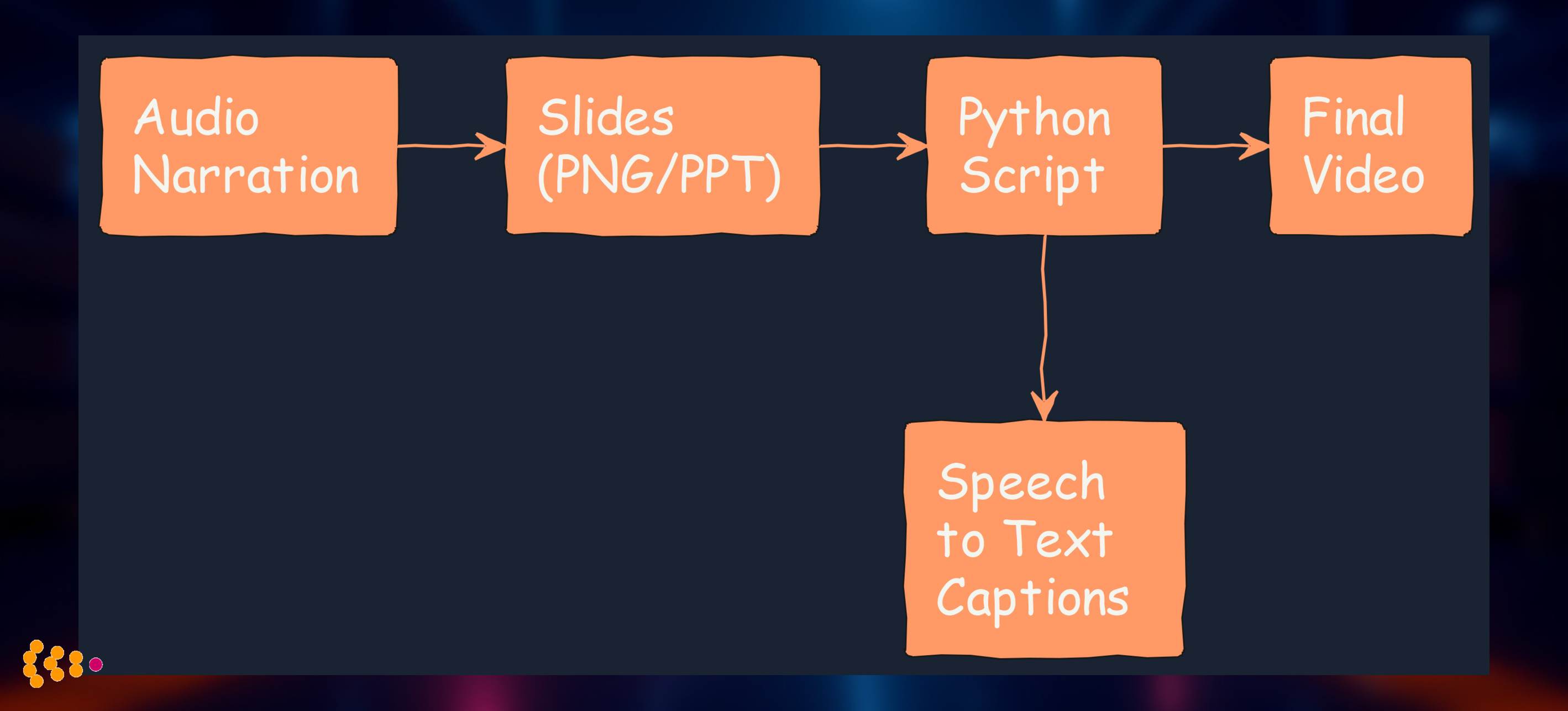
Process:
- Audio narration recorded (faster than video, no visual retakes)
- Slide deck exported as images
- Python automation syncs audio with slide transitions
- Speech-to-text generates SRT captions automatically
- Batch rendering on cloud instances (parallel processing)
- Automated upload to YouTube/LMS via API
Results:
- Production speed: 200 lecture videos in 2 weeks (vs. 6+ months manually)
- Cost efficiency: $20-$50 per video vs. $500-$1,000 manual editing
- Consistency: Uniform branding, captions, transitions
Marketing Automation: From Publication to Promotion
The Marketing Challenge
Publishing a book is only the first step. Marketing requires:
- Email campaigns: Announce new releases to subscriber lists
- Social media: Facebook, Twitter, Instagram posts with cover art, quotes, reviews
- Amazon optimization: Keywords, categories, A+ content
- Advertising: Amazon Ads, Facebook Ads, Google Ads
- Analytics: Track sales, reviews, ad performance
Integrated Marketing Platform
We build marketing automation on top of the publishing CMS:
Features:
1. Email Campaign Automation:
- Trigger: New book published → CMS sends webhook
- Email service (Mailchimp, SendGrid): Creates campaign with book cover, description, purchase links
- Segmentation: Send to subscribers interested in book’s genre/topic
- A/B testing: Test subject lines, send times for best open rates
2. Social Media Scheduling:
- Content generation: CMS provides book cover, title, author quote, purchase link
- Scheduling: Posts queued for optimal times (e.g., 9 AM weekdays for best engagement)
- Platforms: Buffer, Hootsuite integration for cross-platform posting
3. Amazon KDP Optimization:
- Keyword research: Analyze top-selling books in category, suggest keywords
- A+ Content: Generate rich product descriptions with images, comparison charts
- Pricing strategies: Dynamic pricing (e.g., launch discount, seasonal promotions)
4. Ad Campaign Management:
- Amazon Ads: Automated creation of Sponsored Product campaigns with keyword targeting
- Facebook Ads: Dynamic ads with book cover, targeted to readers of similar books
- Budget optimization: AI-driven bid adjustments based on ACOS (Advertising Cost of Sales)
5. Analytics Dashboard:
- Unified view: Sales (Amazon, direct website, other retailers), reviews, ad performance
- Reporting: Weekly/monthly reports to authors showing royalties, sales trends, marketing ROI
Use Case: Fiction Author with 20+ Titles
Before Automation:
- Author manually sent emails via Gmail
- Posted sporadically on Facebook (no schedule)
- Ran Amazon Ads with minimal optimization (wasting budget)
After Automation:
- New release → Automated email to 10,000 subscribers within hours
- Social media posts scheduled for 2-week launch campaign
- Amazon Ads automatically created with optimized keywords
- Author’s time: 10 hours/week on marketing → 2 hours/week (reviewing reports)
Results:
- Sales increase: 40% higher launch week sales (better email/social reach)
- Ad efficiency: ACOS improved from 80% (losing money) to 35% (profitable)
- Author satisfaction: More time for writing, less marketing stress
Print-on-Demand and KDP Integration
The Shift to Print-on-Demand
Traditional printing requires:
- Large print runs: 500-5,000 copies to get reasonable per-unit cost
- Inventory management: Warehousing, shipping logistics
- Risk: Unsold inventory if book doesn’t sell
Print-on-Demand (POD) changes the equation:
- No inventory: Books printed when ordered
- Global distribution: Amazon, IngramSpark have printing facilities worldwide
- Low risk: No upfront printing costs
Automated KDP Publishing
We integrate CMS with Amazon Kindle Direct Publishing (KDP) API:
Workflow:
- Author uploads manuscript to CMS (Word doc, Markdown, or direct editing)
- CMS converts to EPUB (e-book), PDF (print), MOBI (legacy Kindle format)
- Automated upload to KDP:
- Book metadata (title, author, description, keywords, categories)
- Cover image (generated or uploaded)
- Interior PDF (for print)
- EPUB or MOBI (for e-book)
- Pricing (set per territory: US, UK, EU, etc.)
- KDP review (usually 24-48 hours)
- Publication: Book goes live on Amazon
- Notification: Author receives email confirming publication + Amazon links
Technology:
- KDP API: RESTful API for uploading books, managing metadata, setting prices
- PDF generation: LaTeX or Pandoc for high-quality print PDFs (bleed, trim marks, proper margins)
- EPUB generation: Pandoc or custom Java library (EPUBCheck validation)
Benefits:
- Speed: Publish within hours of manuscript finalization (vs. weeks for traditional publishing)
- Global reach: Immediately available in Amazon stores worldwide (US, UK, DE, FR, JP, etc.)
- No technical knowledge: Authors focus on writing; CMS handles formatting and publishing
Global Reach: Multi-Territory Publishing
The Challenge
Publishers often have:
- Territory-specific rights: Licensed to publish in EU but not US, or vice versa
- Localization requirements: Different covers, titles, or content for different markets
- Pricing strategies: EUR prices for EU, GBP for UK, USD for US—not just currency conversion
- Tax and legal: VAT in EU, sales tax in some US states, different copyright laws
Solution: Territory-Aware Publishing Platform
Features:
1. Rights Management:
- CMS tracks which territories/formats publisher has rights to distribute
- Prevents accidental publication in restricted territories
2. Localized Metadata:
- Different book descriptions for different markets (US English vs. UK English, cultural references)
- Territory-specific keywords (e.g., “fall” in US vs. “autumn” in UK)
3. Pricing Engine:
- Base price set in publisher’s home currency
- Territory-specific adjustments (not just exchange rate, but local market pricing)
- Automatic updates when exchange rates fluctuate
4. Distribution Routing:
- Amazon KDP for most territories
- IngramSpark for wider distribution (bookstores, libraries)
- Direct sales for territories without KDP availability
Use Case: EU Publisher Expanding to US Market
Before: Publisher manually created US-specific versions, uploaded separately, managed pricing in spreadsheets.
After: CMS manages all territories from single interface:
- Set EUR price → System calculates USD, GBP equivalents with local market adjustments
- Upload manuscript once → System generates territory-specific versions (if needed)
- Publish → Goes live on Amazon.com (US), Amazon.co.uk (UK), Amazon.de (Germany) simultaneously
Results:
- Global sales: US sales grew from 10% to 30% of total revenue (better optimization)
- Reduced errors: No more pricing mistakes or accidental publishing in restricted territories
- Faster expansion: New territories added in days (vs. months of manual setup)
Lessons Learned: Publishing Technology Since 2011
1. Content is King, But Workflow is Queen
Great content won’t reach readers without efficient workflows. Publishers that invest in automation, integration, and systems thinking outperform those with ad-hoc processes.
2. Embrace Multi-Format from Day One
Don’t design for print and retrofit for e-books. Start with structured content (XML, Markdown) that can render to any format. Print, EPUB, web, audiobook—all from the same source.
3. Metadata Matters More Than You Think
Rich, accurate metadata is the foundation of discovery (SEO, Amazon search), rights management, and analytics. Invest in metadata capture and management early.
4. Automation Doesn’t Replace Creativity
AI narration and video automation are tools, not replacements for human creativity. Use automation for efficiency; reserve human effort for high-value creative decisions (which books to publish, cover design, editorial direction).
5. APIs and Integrations Age Quickly
APIs change. Amazon updates KDP API, email providers deprecate old versions. Build abstraction layers so you can swap integrations without rewriting core systems.
The Future of Publishing Technology
AI-Driven Content:
- AI editing assistants: Grammar, style suggestions powered by GPT models
- Dynamic content: E-books that adapt to reader preferences (difficulty level, detail depth)
- Personalized covers: AI-generated cover art variations tested with target audiences
Blockchain for Rights:
- Smart contracts: Automated royalty payments via blockchain
- Rights marketplaces: Buy/sell territorial rights via decentralized platforms
Interactive Media:
- Enhanced e-books: Embedded videos, quizzes, interactive diagrams
- Augmented reality: Physical books with AR content via smartphone apps
Direct-to-Consumer:
- Publisher-owned storefronts: Reduce dependence on Amazon with direct sales platforms
- Subscription models: “Netflix for books” via publisher subscriptions
We’re helping publishers navigate this rapidly evolving landscape—building systems today that can adapt to the innovations of tomorrow.
Conclusion
Since 2011, we’ve supported publishers across the EU and worldwide in building the technical infrastructure for modern publishing:
- Custom CMS platforms tailored to editorial workflows
- Audio and video production automation for cost-effective multimedia content
- Marketing automation integrated with publishing pipelines
- KDP and print-on-demand integration for global distribution
- Multi-territory rights and pricing management
Publishing has transformed from a print-centric industry to a multi-format, global, technology-driven business. The publishers thriving today are those that embrace automation, integration, and systems thinking—using technology to amplify creativity, not replace it.
Technologies Used: Java/Spring Boot, PostgreSQL, Git, Camunda BPMN, Pandoc, LaTeX, EPUBCheck, Angular, React, Amazon KDP API, IngramSpark API, Mailchimp, SendGrid, Google Cloud TTS, ElevenLabs, AWS Transcribe, MoviePy, FFmpeg
Industries Served: Trade publishing (fiction, non-fiction), Educational publishing, Academic presses, Self-publishing services
Global Reach: Clients in Germany, UK, France, Netherlands, Austria, Switzerland, US, Canada
Contact: Building a publishing platform or automating your production workflow? Let’s discuss your needs.